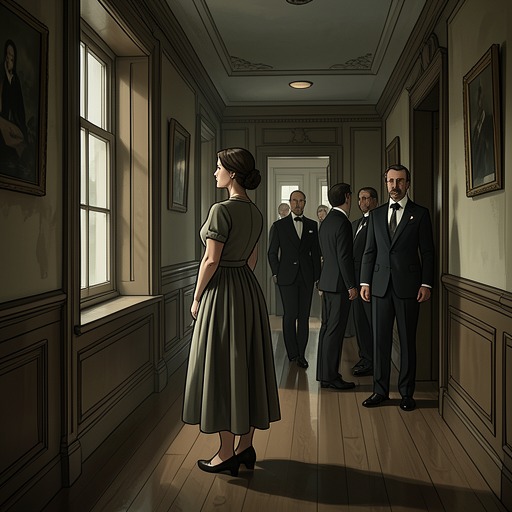
Appearance versus reality
Uncle SilasAppearance versus reality is a governing tension in Uncle Silas: people’s polished manners and confident accounts of themselves cannot be taken at face value, yet Maud’s own fearful perceptions are also vulnerable to error. The distinction is not merely philosophical. Silas’s gentle manner helps him present himself as scrupulous while dismissing evidence that threatens his authority over Maud; the novel’s uncertainty about what Maud sees makes that dismissal harder, not easier, to resist.
Silas’s Performance of Scruple
When Doctor Bryerly challenges the handling of Maud’s affairs, Silas bows and presents the encounter as an opportunity for openness. He says he sent for Maud so she could hear Bryerly’s views, and frames the accusation as an insinuation that he is robbing her. Bryerly answers in the language of legal and moral distinctions: taking what does not belong to someone and converting it to one’s use would more nearly resemble thieving than robbery. The terminology does not soften the charge. Silas’s lip, eyelid, and thin cheek quiver, but he recovers his self-command with a chilly, sarcastic laugh and a glance at Maud. His composed surface and involuntary reaction point in opposite directions.
After Bryerly has left, Silas invokes the prayer against temptation and says it should not be mocked by deliberately walking into temptation. He then explains that he has forbidden Bryerly from the house both because the doctor’s unconscious insolence tests his patience and because he has heard unfavourable reports about him. Silas insists that he understands the disputed question of right: he describes himself as Maud’s tenant and guardian, claims that she will later see how carefully he stayed within his legal privileges despite extreme financial difficulties, and calls himself pure through miraculous strength and grace. The self-description makes his public claim to scruple central to the dispute, but it is still Silas who supplies the account and controls which adviser Maud may hear.
His account of conversion extends the same divide between outward judgment and inward truth. Silas says that the world cannot believe in a person’s conversion, then names his former self as a reckless prodigal and godless profligate, insisting that he is now a sinner saved. His speech turns mystical, invoking the deluge and the waters of Mara, and he says he is washed and sprinkled before bathing his temples and forehead with eau de Cologne. Maud cannot follow his excursions into symbolism. The scene leaves the claims of spiritual renewal beside an oddly concrete gesture: a man’s professions of inner purification are accompanied by an outward application of scent.
Maud’s Uncertain Perceptions
The novel also tests appearance through Maud’s experiences of fear. During a vigil in a ghastly room, with Milly asleep and Maud alone awake, practical troubles already occupy her thoughts: Dudley’s audacious suit, Silas’s questionable toleration of it, and Maud’s own conduct during that unhappy period. She is also thinking of Cousin Knollys and Lord Ilbury when she looks toward the door and sees what seems to be part of a human face, with a glimpse of fingers. In the imperfect light it resembles a livid mask with chalky eyes, staring toward the bed.
Maud has previously been startled by apparitions produced when accidental light and shadow disguise familiar objects. She expects this sight to dissolve in the same way, but instead becomes certain that the face is Madame de la Rougierre’s. She cries out and shakes Milly awake. The scene offers no detached confirmation of what Maud sees: it is told through her perception, where an awareness of possible illusion collides with the conviction of recognition. Because Maud knows that shadows have deceived her before, the vision cannot be reduced to a simple contrast between a truthful witness and a false appearance. Fear can distort what is visible, but the possibility of distortion does not make her experience unreal to her.
The question of whether an appearance can be trusted returns the following morning. After a night of broken sleep and agitation, Maud is summoned to Silas’s room. She thinks his manner has changed: he remains gentle, kind, smiling, and submissive, yet seems to shrink from meeting her eyes. When she looks at him, his gaze is on the book before him; when he speaks, an inattentive listener might think he is reading aloud. Maud cannot identify a tangible cause for this new aversion. She wonders whether it comes from shame or contains a shade of horror, and cannot tell whether a dream, voice, or vision has contributed to it. His increased kindness does not settle the question; it makes the contrast between outward tenderness and apparent repulsion more striking.
Credibility as a Means of Control
The sharpest conflict between appearance and reality comes when Maud confronts Silas and Madame de la Rougierre with an accusation. Madame denies the account with cool effrontery, solemn assurances, streaming eyes, clasped hands, and a theatrical plea that Maud withdraw the story and do her justice. Maud turns at once to Silas and insists that every syllable is true. One woman offers an emotionally staged denial; the other claims to report what she witnessed. The scene makes performance itself part of the evidence, but Madame’s display does not independently establish what happened.
Silas declines to treat Maud’s certainty as sufficient. He points to Madame’s denial and says she arrived excellently recommended by the superior of the place where Milly is waiting. He presents the situation as a conflict between accounts, says he sees a presumption of mistake, and claims that he would prefer that explanation to assuming guilt. His language sounds measured and fair: he does not openly call Maud a liar, but recasts her report as error and Madame’s testimonials as grounds for trust.
The consequence is immediate. Maud has witnessed what she describes with minuteness and consistency, and repeats her account with earnestness, yet feels that she is beating the air. Silas receives her insistence with a simper of feeble incredulity, pats and smooths her head, and laughs gently as she protests. Madame, meanwhile, continues with tranquil tears and mild prayers for Maud’s enlightenment and reformation. Silas concludes that the incident is a delusion and tells Maud to exercise self-command and good sense, not add to the perplexities that torture him, and make herself happy with Madame, who will be her companion for three or four weeks at most. His solicitude becomes a means of overriding her testimony: the language of care and moderation leaves the accused woman in place and isolates Maud with the person she fears.
The Cost of the Divide
These episodes distinguish appearance from reality without supplying a simple key that makes every surface transparent. Silas may describe himself as legally scrupulous and spiritually transformed, but his conduct in the disputes over Maud’s interests, his control of Bryerly’s access, and his dismissal of Maud’s accusation place those claims under pressure. His calm does not prove innocence; nor does Maud’s distress, by itself, prove every interpretation she makes. The difficulty is that Silas has the power to decide which appearances count as credible. He can treat his own account as sober judgment while classifying Maud’s as delusion, even when she insists that she saw the event clearly.
The resulting danger lies in the unequal consequences of doubt. When Maud questions her vision, she knows the mind can mistake shadows for a face. When Silas calls her report a mistake, his judgment determines what happens next: Madame remains to accompany her, and Maud is urged to suppress her alarm. The novel’s recurring contrast between a composed exterior and hidden or uncertain truth therefore has practical force. It shapes whose testimony is heard, whose motives remain suspect, and whether Maud can act on what she believes she has seen.